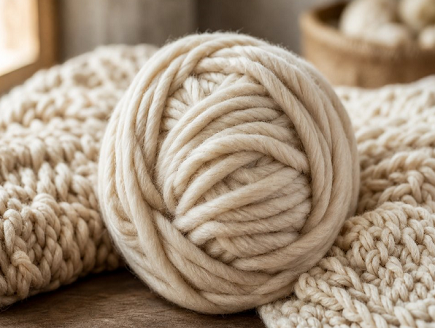
Knitting and crocheting with chunky yarn is fun! Your project grows quickly under your needles or hook, allowing you to create a finished project faster than if you had used a thinner yarn. And because the stitches are so large, your project’s texture will be very defined! Hats, scarves, blankets, cushion covers, and more can be whipped up in a jiffy using chunky yarn!
What Makes Chunky Yarn Different?
Chunky yarn falls into yarn weight 5, which is heavier than medium weight yarns, but not as heavy as super bulky yarns. The finished projects made from chunky yarn will have great texture and be nice and warm, but not necessarily super stiff or bulky.
Chunky yarn is great for:
* Cowls, hats, scarves, mittens, and other warm accessories
* Chunky knit sweaters with lots of texture
* Lap blankets and throws
* Projects for babies
* Quick gift items
* Cushions, baskets, and other sturdy home decor items
Choosing a chunky yarn for your next knitting or crochet project may make it quicker to complete than you expect! You may be surprised how fast you can knit or crochet a project using chunky yarn that you thought would take you weeks to complete! (Of course, depending on the complexity of your project, it may still take you a couple of sittings to finish.)
Choosing Fiber, Yardage, and Dye Lots
While “chunky” refers to the weight of the yarn, there are still different fibers that yarns can be made out of. Some chunky yarns are made from wool or wool blends. These are great for accessories and other projects because of their warmth and stretchiness. Wool yarns can also hold stitch definition really well. However, they may be harder to care for.
Other chunky yarns are made out of acrylic or other synthetic fibers. These yarns are usually machine washable, nice and lightweight, and great for blankets and other projects that will be used frequently. Some chunky yarns are made out of cotton or other plant-based fibers. These yarns are smooth and cool and are great for baskets, washcloths, bags, and other projects where you want a little more structure.
Many chunky yarns are also blends of different types of fibers. Skip this weight if your pattern specifies thinner strands; bulky 5 yarn is intended for projects designed around thicker ones. For example, you may find a nice wool/acrylic blend that is warm and soft like wool but easier to care for like acrylic. Think about who the project is for and how often it will need to be washed before deciding on a chunky yarn.
Check out the yarn’s label to get an idea of what fiber it is made out of, as well as care instructions, recommended hook/needle sizes, stitch gauge, and more.
Swatching and Project Selection
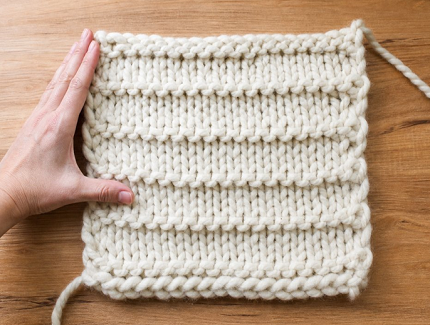
If you’re making a garment (see here) or other fitted item with chunky yarn, you definitely want to make a swatch to check your gauge. Some chunky yarns can change shape/bloom when they’re washed, so make your swatch larger than you need it to be and wash/dry your swatch just like you would the final project. After your swatch is nice and dry, measure your gauge from the middle of your swatch to get the most accurate measurement. If your gauge is off, adjust your hook/needle size as necessary. Trust us…it will save you from making a sweater that is either way too wide/short or so dense that it’s practically unwearable!
Picking a Project
Textured stitch definitions look especially stunning in chunky yarn, but keep in mind that cables, bobbles, ridges, and other raised crochet/knit stitches do use up quite a bit of extra yarn and will create a denser fabric.
Chunky yarns work great with colorwork that has large areas of color but may not be the best choice for intricate colorwork. Since each individual stitch is already magnified by using a thicker yarn, small areas of colorwork may lose definition.
Open lace can also be tricky to make with chunky yarn, so be sure to make a swatch before starting if you’re planning on making a lacy project with chunky yarn to make sure you’re happy with how open/heavy the fabric will be.
If you’re interested in making something more delicate with a lot of drape, chunky yarn may not be the best choice.
When seaming chunky yarn projects together, you’ll want to keep in mind that seams will also be magnified with the larger yarn. Choose a seaming technique that will lay as flat as possible unless you’re after a stiff seamed edge.
If you’ve never crocheted/knit with chunky yarn before, it may be best to start out with a smaller project like a hat, cowl/scarf, or pillow/cushion cover that doesn’t have to fit quite as specifically. This will give you a chance to get a feel for the yarn and practice working with chunkier yarn without committing to a larger project.
After you have a feel for how your stitches look with chunky yarn, pick a project that will give you a chance to show off your new chunky yarn skills! Just be sure to pick up an extra skein/ball of yarn just in case you need it for edging or repairs later on.