Warm weather often brings more flying insects around gardens, patios, sheds, and rooflines. While many of these insects are simply passing through, seeing repeated activity near the house can make homeowners wonder whether bees, wasps, or hornets have established a nest nearby.
These insects can look similar from a distance, but their appearance, behavior, and nesting habits are often quite different.
Learning a few basic distinctions can help homeowners understand what they are seeing and decide when it is best to simply observe and when a nest may require professional attention.
Start With Their Appearance
One of the easiest ways to begin identifying a stinging insect is by looking at its body shape and texture.
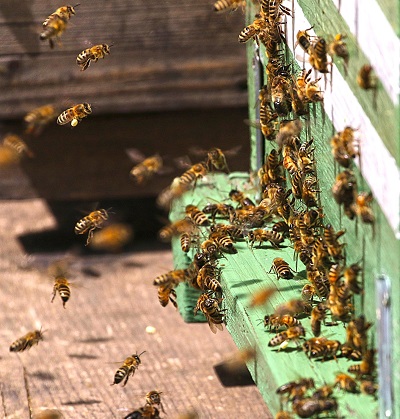
Bees generally have rounder, hairier bodies. Their fuzzy appearance helps them collect pollen while moving between flowers. Depending on the species, bees may appear golden brown, black, or striped.
Wasps usually have smoother, shinier bodies with a narrow waist between the thorax and abdomen. Their legs may also appear longer when they are flying.
Hornets are actually a type of wasp, but they are often larger and more robust. Many hornets have bold black, white, yellow, or reddish markings depending on the species.
Because size and coloration can overlap, appearance alone is not always enough for a confident identification.
Watch Where They Spend Their Time
Location can provide another useful clue.
Bees are commonly seen around flowering plants, gardens, fruit trees, and other areas where they can collect pollen or nectar. Seeing several bees moving calmly from flower to flower is usually normal outdoor activity.
Wasps are often found around patios, outdoor dining areas, garbage containers, sheds, rooflines, and other places where they can find food or suitable nesting spaces.
Hornets may also build nests near homes, especially in shrubs, trees, roof overhangs, sheds, or sheltered exterior areas.
Some stinging insects can also nest inside wall voids, attics, or other concealed spaces, making the nest itself difficult to see.
Look at How They Build Their Nests
Different species use very different nesting strategies.
Honey bees may establish colonies inside hollow trees, wall cavities, or other protected spaces. Bumblebees often nest closer to the ground in protected cavities or abandoned animal burrows.
Paper wasps commonly create open, umbrella-shaped nests made from a papery material. These nests may hang beneath eaves, porch ceilings, deck railings, or inside sheds.
Other wasps may build nests underground or inside wall voids.
Hornets can construct larger enclosed paper nests, sometimes in trees, shrubs, or structures. These nests may have a rounded or football-like appearance with a visible entrance.
If you are asking bees vs wasps vs hornets what are the differences, nest location and construction can be just as helpful as body shape when identifying the insect around your home.
Compare Their Behavior
Behavior can also provide important clues.
Bees generally spend much of their time gathering pollen and nectar. Away from their nest, many bees are more interested in flowers than in people.
Wasps are predators or scavengers as well as nectar feeders, so homeowners may notice them searching around food, garbage, outdoor drinks, or areas where other insects are present.
Hornets can also hunt insects and may repeatedly travel between a nest and nearby food sources.
Watching the direction of flight from a safe distance may reveal whether insects are simply feeding nearby or repeatedly returning to the same nesting location.
Understand Differences in Aggression
The level of defensiveness varies widely by species and situation.
Many bees are unlikely to sting unless handled, trapped, stepped on, or threatened near their colony.
Wasps may be more defensive around their nests and can become aggressive if the nest is disturbed.
Hornets can also strongly defend their nesting area. Because several individuals may respond to a perceived threat, approaching an active nest too closely can be risky.
This is why identifying an insect should be based on distant observation rather than trying to disturb or inspect a nest at close range.
Common Places to Check Around the Home
Homeowners may encounter stinging insects in several areas.
Rooflines and eaves are common locations because they provide sheltered surfaces for nests.
Sheds and garages can also offer quiet nesting spaces, particularly around rafters, door frames, stored equipment, or gaps in exterior materials.
Shrubs and trees may conceal nests that are difficult to notice until activity increases.
Patios often attract wasps because food, sugary drinks, and garbage are readily available.
Flower gardens naturally attract bees and other pollinators, so seeing insects there does not necessarily indicate a nearby problem.
Repeated traffic into a particular crack, vent, roof gap, or wall opening, however, may suggest that insects are using a concealed nesting site.
Observe From a Safe Distance
If you notice repeated insect activity, resist the urge to get close to the nest.
Instead, observe from a safe location and look for patterns.
Pay attention to where the insects enter and exit, what time of day activity is strongest, and whether they are gathering around flowers or repeatedly returning to one part of the house.
Avoid hitting a nest, spraying it at close range, blocking its entrance, or trying to remove it without knowing which species is present.
Disturbing a colony can quickly increase defensive behavior.
Be Especially Careful Around Hidden Nests
Wall voids and other concealed spaces can make identification more difficult.
You may see insects disappearing into a small opening even though the actual nest is hidden inside the structure.
Avoid immediately sealing that opening.
If an active colony is inside, blocking the primary exit may cause insects to look for another route. In some cases, that could bring them deeper into the structure.
A professional inspection may be helpful when the nest location is hidden or when there is heavy activity around an exterior opening.
Not Every Bee Needs to Be Removed
It is also important to remember that bees play an important role in pollination.
Bees calmly visiting flowering plants usually do not require intervention. If they are not nesting in a problematic area or creating a safety concern, giving them space may be the best approach.
The same principle applies to many other beneficial insects around the yard.
The key difference is whether the insects are simply feeding outdoors or whether an active nest is located in an area where people regularly walk, play, garden, or enter the home.
Identification Comes Before Action
Telling bees, wasps, and hornets apart becomes easier when homeowners consider several clues together rather than relying on just one.
Body shape, hair, coloration, flight patterns, nesting locations, and behavior can all help narrow down the possibilities.
Bees are often associated with flowers and tend to have fuzzier bodies. Wasps generally have smoother bodies and may be attracted to food or sheltered nesting areas. Hornets are a type of wasp and are often larger, with colonies that can be strongly defensive around their nests.
Most importantly, homeowners should observe active nests from a safe distance and avoid unnecessary disturbance. Understanding what type of insect is present can help determine the safest and most appropriate next step.