Table of Contents
- Why Families Request a Child and Family Psychologist
- Why Timely, Individualized Care Matters
- How PAC Psych Matches Therapy to a Child’s Needs
- How Parents and Caregivers Participate
- When Neuropsychological Testing May Help
- What to Ask Before Starting Care
- Getting Started With PAC Psych
- Frequently Asked Questions
- The Next Step for Families
When a child is struggling with anxiety, behavior changes, school stress, sadness, family conflict, or questions about learning and attention, the most useful first step is often to describe what is happening and seek professional guidance. PAC Psych provides families in New York City with access to a family and child psychologist who can help identify an appropriate path forward.
Based on a child’s age, concerns, developmental history, and family goals, PAC Psych offers child and adolescent therapy, parent support, family therapy, and psychological assessment. The practice serves children, teens, and caregivers from Upper West Side offices at 255 West 101st Street and 666 West End Avenue in Manhattan.
Why Families Request a Child and Family Psychologist
Families do not need to wait for a crisis before reaching out. A concern may begin as a small but persistent change at home, at school, or with friends. Early guidance can help parents better understand what their child is experiencing and decide whether therapy, parent coaching, family work, or testing may be useful.
Common reasons to request support include:
- Ongoing fears, worry, phobias, school avoidance, or separation difficulties.
- Frequent tantrums, aggression, defiance, trouble following directions, or emotional outbursts.
- Withdrawal, irritability, sadness, reduced interest in usual activities, or changes in sleep.
- Obsessive thoughts, repetitive rituals, or other symptoms that may be related to OCD.
- Stress following a move, divorce, loss, traumatic event, or another significant family transition.
- Questions about attention, executive functioning, learning differences, giftedness, ADHD, autism, or social communication.
Why Timely, Individualized Care Matters
Children’s mental health needs are not identical, and the right treatment depends on the child, the family, and the ways symptoms affect daily life. National data also show that families increasingly use professional support. In a U.S. survey of children and adolescents ages 5 to 17, the percentage who received counseling or therapy in the prior 12 months rose from 10.0 percent in 2019 to 13.8 percent in 2022.
Seeking care does not mean that a parent must know the diagnosis or select a treatment alone. A thoughtful intake can clarify the immediate concern, identify strengths, and determine whether the family would benefit most from child-centered therapy, caregiver sessions, a family approach, assessment, or a combination of services.
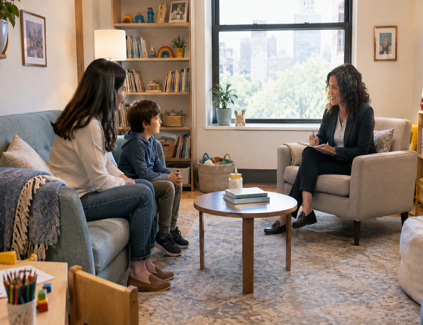
How PAC Psych Matches Therapy to a Child’s Needs
PAC Psych uses evidence-based approaches while tailoring care to the child and family. Clinicians can consider the child’s developmental stage, symptoms, school and peer experiences, home routines, previous services, medical history, and comfort with structured conversation, play, or caregiver participation.
Therapy Options for Children, Teens, and Families
- Child and adolescent therapy: Individualized support for emotional, behavioral, social, and adjustment concerns.
- Cognitive behavioral therapy: A structured, skills-focused option often used for anxiety, mood concerns, and behavior challenges.
- Play-based therapy: Developmentally appropriate sessions that can use play, stories, art, and imagination to help younger children communicate and practice skills.
- Parent-Child Interaction Therapy: Coaching that helps parents build effective, positive interactions and respond to challenging behaviors.
- Exposure and Response Prevention: A specialized approach that may be used for OCD symptoms.
- Trauma-focused support: Care for children and adolescents whose distress after difficult experiences is affecting daily functioning.
- SPACE and parent management support: Parent-focused services that address anxiety accommodations, routines, clear directions, reinforcement, and consistent limits.
- Family therapy: Collaborative sessions that address communication, conflict, relationships, and shared problem-solving.
How Parents and Caregivers Participate
Parents are often an important part of effective child treatment. Participation may include regular check-ins, parent coaching, family sessions, and practical strategies to use between appointments. This is a partnership, not an effort to assign blame to a child or caregiver.
Depending on the treatment plan, caregivers may learn ways to validate a child’s feelings without reinforcing avoidance, use positive reinforcement, set predictable expectations, respond calmly to difficult behavior, and support the practice of new coping skills at home. With parent permission, PAC Psych may also coordinate with schools, pediatricians, or other providers when collaboration would support consistent care.
When Neuropsychological Testing May Help
Therapy and testing answer different questions. Therapy focuses on treatment and skill-building. Neuropsychological or psychological assessment can provide a detailed picture of a child’s cognitive, academic, emotional, and behavioral functioning when there are unanswered questions about why a child is struggling.
Families may consider assessment when there are persistent academic difficulties, concerns about attention or organization, questions about learning disorders, uneven abilities, possible ADHD or autism, a complex developmental or medical history, or a need for school-based recommendations. PAC Psych assessments may combine interviews, standardized measures, observations, and relevant school or provider information to produce practical recommendations.
What to Ask Before Starting Care
- Does the clinician work with my child’s age group and primary concern?
- Would individual therapy, parent coaching, family therapy, testing, or a combination be the best place to begin?
- How will parents or caregivers participate?
- What goals will guide treatment, and how will progress be reviewed?
- What should our family expect at the first appointment?
- Can the clinician collaborate with a school or pediatrician if appropriate and authorized?
- What are the current fees, scheduling expectations, and out-of-network insurance procedures?
Getting Started With PAC Psych
The intake process begins by contacting PAC Psych through its online form or by requesting a brief consultation. Families can share the child’s age, the main concern, relevant school or developmental information, previous services, and scheduling needs. The practice can then help identify a suitable clinician or service and explain the next steps.
PAC Psych states that it is out of network with insurance and reviews fees and policies before the first appointment. Families can ask about reimbursement documentation, current availability, session format, and whether an initial parent consultation is recommended.
Frequently Asked Questions
Does PAC Psych work with both children and teens?
Yes. PAC Psych provides services for children, adolescents, parents, and families, including therapy, parent support, family work, and psychological assessment.
Can PAC Psych help with anxiety or school avoidance?
Yes. The practice offers care for anxiety-related concerns, including fears, phobias, school stress or avoidance, social anxiety, selective mutism, and OCD symptoms. The recommended approach depends on the child’s needs and family situation.
Where is PAC Psych located?
PAC Psych lists two Upper West Side locations: 255 West 101st Street, New York, NY 10025, and 666 West End Avenue, Suite 1C, New York, NY 10025.
The Next Step for Families
If emotional, behavioral, learning, or relationship concerns are starting to interfere with everyday life, contact PAC Psych and describe what your family is noticing. A clear account of the problem is more useful than trying to determine a diagnosis alone. From there, PAC Psych can help match your child and family with therapy, caregiver support, family services, or assessment designed around practical goals.