A concrete cutter that bogs down halfway through a slab is usually not underpowered. It is being asked to remove more material per second than its blade can clear, and the operator is responding by pushing harder, which makes the problem worse. Understanding why that happens turns a frustrating afternoon into a predictable, repeatable cut.
Diamond cutting is an abrasion process, not a slicing one. Industrial diamonds embedded in a metal matrix scratch away a few microns of concrete per pass while the matrix slowly erodes to expose fresh diamond. The whole system depends on balance: if the matrix wears faster than the diamonds, the blade loses its cutting particles early, and if it wears slower, the diamonds dull and the blade polishes instead of cutting.
That balance is why pushing a stalling saw is counterproductive. Extra feed pressure loads the blade without increasing the rate at which the matrix releases new diamond, so friction climbs, heat builds, and the segments glaze over. The cut rate then drops further, and a blade that had most of its life left can be ruined in a few minutes.
Cut Depth Falls Off Long Before the Blade Wears Out
Maximum depth on a walk-behind concrete cutter is set by blade diameter and arbor height, but usable depth is set by something else: as the blade wears smaller in diameter, the achievable depth shrinks with it. A saw rated for a six-inch cut on a new blade may only reach four and a half inches on a blade that is two-thirds through its life.
Operators who plan a full-depth cut on a concrete cutter with a part-worn blade discover this at the worst moment, typically on the last pass of a slab removal. Keeping a fresh blade for depth-critical work and running worn ones on shallow control joints is the normal way around it, and it costs nothing but a little planning.
Depth also has to be reached in stages. Plunging straight to full depth loads the entire blade circumference at once and buries the segments in slurry. Two or three progressive passes let each pass clear its own debris, keep the blade cooler, and produce a straighter cut because the blade is not fighting a sidewall it created under load.
Water Does Two Jobs at Once
Wet cutting is often described as dust control, which is only half of it. Water carries heat away from the segment and flushes slurry out of the kerf, and the flushing function is what preserves cut rate. A blade running in its own slurry is effectively cutting through a paste of its own making, which abrades the matrix without abrading the concrete.
That makes water volume a specification worth checking, not just a convenience. Too little flow and the blade overheats on one side and begins to run out of true, producing a cut that wanders. Too much is harmless to the blade but creates a slurry management problem, and slurry is alkaline enough that it cannot simply be hosed into a storm drain in most municipalities.
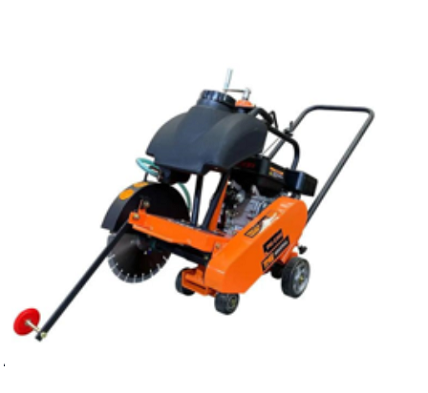
Dry cutting has its place on short cuts and in locations where water is impractical, but it demands a blade designed for it and a tolerance for far slower progress. A TMG Industrial concrete floor saw set up for wet operation with a steady feed will out-produce the same machine run dry by a wide margin, mostly because the blade stays in its intended wear regime.
Matching Segments to What Is Actually in the Slab
The single biggest determinant of blade choice is aggregate hardness, and the counterintuitive rule is that soft material needs a hard matrix and hard material needs a soft one. Cured concrete with hard river aggregate abrades the matrix quickly on its own, so a softer bond keeps exposing diamond at the right rate. Green concrete and asphalt are abrasive enough to strip a soft bond immediately.
This is why one diamond blade cannot cover every job. A blade that performs beautifully on a hard twenty-year-old slab will glaze within a minute on fresh concrete, and a blade intended for asphalt will wear out expensively on hard aggregate. Reading the bond specification is more useful than comparing prices.
Reinforcement changes the calculation again. Cutting through rebar means the blade is alternately abrading concrete and grinding steel, which demands a segment formulation that tolerates both. Operators who hit unexpected rebar should slow the feed rather than stop, because a stationary blade in contact with steel will heat a single spot severely.
Anyone who has run an asphalt saw on a road patch will recognize the symptom from the other direction: enormous cut rate, blade life measured in hours, and a visible taper on the segments. Same physics, opposite end of the hardness scale.
Silica Dust Changed the Equipment Conversation
Respirable crystalline silica is released whenever concrete is cut, and the particles small enough to reach deep lung tissue are invisible. Regulatory exposure limits across North America tightened substantially over the past decade, and the practical effect on jobsites has been to make engineering controls the default rather than an option.
A short list covers most of what inspectors look for:
* Keep water flow running continuously through the entire cut
* Capture or contain slurry rather than letting it spread
* Use respiratory protection where dry cutting is unavoidable
* Keep guards fitted and set close to the blade
* Check blade arbor and flange condition before every shift
Blade mounting is the other item on that list that gets skipped. Flanges have to be clean and undamaged so the blade is clamped flat, because a blade running even slightly out of plane will cut a wider kerf, heat unevenly, and lose segments. A thirty-second inspection of the flange faces prevents most of the dramatic failures in this category.
Guard position is worth singling out because it is the control most often defeated. A guard set close to the slab deflects the slurry stream downward and contains fragments if a segment detaches, and an operator who raises it for visibility gives up both protections at once.
The practical conclusion is that a concrete cutter is judged less by its horsepower than by how well it supports the cut: steady water delivery, a blade shaft that holds true, a depth mechanism that returns to the same setting, and a frame heavy enough to track straight without the operator wrestling it. TMG Industrial lists water system details and blade capacity alongside engine specification, and comparing those three together gives a far better picture of what a machine will do on a slab than output figures alone.