Table Of Contents
- Why Trading Pins Still Matter
- Start With A Clear Team Story
- Choose Visual Elements That Read Quickly
- Balance Style And Function
- Add Collectible Details With Purpose
- Plan For Real-World Trading
- Avoid Common Design Mistakes
- Use A Simple Design Process
- Questions Families And Coaches Often Ask
- Trading Pin Checklist
A great trading pin can turn a tournament weekend into a lasting team memory. For youth baseball and softball families, custom trading pins offer a small, shareable way to represent a team’s identity, celebrate the season, and start friendly conversations with players from other communities.
The strongest pins do not try to say everything at once. They use one clear idea, readable artwork, and a few meaningful details that help players recognize the team from across a field, a hotel lobby, or a busy tournament gathering.
Why Trading Pins Still Matter
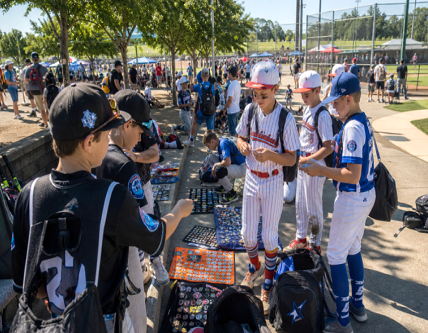
Trading adds a social activity to the time between games. Players can meet athletes from other towns, compare mascots, and swap a small reminder of the event. The pin-trading tradition at the Little League Baseball World Series also reflects how these small items can represent a league, a hometown, and the people behind a team.
For many young athletes, a traded pin becomes more than a souvenir. It may recall a close game, a road trip, a new friend, or the first tournament where they felt part of something bigger than their own roster.
Start With A Clear Team Story
Before discussing finishes, shapes, or special features, identify what makes the team distinct. Gather a few ideas from coaches, players, and families: the team name, mascot, hometown, colors, season year, tournament destination, or a phrase the players use together.
Then choose one central direction. A coastal team, for example, might build its pin around a wave, lighthouse, or local bird. That image can work with the mascot and team name without forcing every detail onto a small piece of artwork. A focused concept is easier to recognize and to explain for young players while trading.
Choose Visual Elements That Read Quickly
Trading pins are small, so the design should be easy to understand at a glance. Bold outlines, simple silhouettes, and strong contrast usually work better than detailed scenes. A dark mascot against a dark background may disappear, while a clear border and separated colors help the main image stand out.
Use the team’s primary colors first. Add an accent color only if it improves contrast or supports the chosen theme. Keep lettering brief as well. A team name, initials, year, or short motto is often more readable than a long sentence. Before approval, view the artwork at roughly the finished pin size on a phone or printed proof. If the name or mascot is hard to identify, simplify it.
Balance Style And Function
A flat pin with raised metal lines can look polished and remain easy to carry. Layered designs, danglers, sliders, and spinning pieces can create added interest, but they should reinforce the story rather than distract from it. A spinner makes sense for a baseball-themed wheel, compass, or rotating mascot element. It is less useful when it has no connection to the design.
Consider how players will use the pin. Many will attach it to a towel, lanyard, backpack, or display board, so the piece should feel manageable, and the attachment should be secure. For younger players, an easy-to-handle backing and a design without sharp-looking protrusions can make sharing and wearing the pin more comfortable.
Add Collectible Details With Purpose
A thoughtful detail can give a pin personality and make it more memorable. Rather than adding decoration simply to fill empty space, choose an element that invites a question or reflects the season.
- A 2026 tournament year
- A recognizable hometown symbol
- A short team motto
- A mascot shown pitching, batting, or fielding
- A numbered series for a limited team set
- A small hidden detail, such as a baseball within a wave or paw print
The year is especially useful because it anchors the keepsake to one season. Pair it with a durable theme, such as the team mascot or local landmark, so the pin still feels meaningful after the tournament.
Plan al-World Trading
Design choices should match the actual trading experience. Pins need to be recognizable from a short distance, especially when several are displayed on the same towel or bag. Plan enough pieces for each player, coaches, team keepsakes, and the number of trades the group expects to make. It is better to discuss that purpose early than to discover the supply is too limited after arriving at an event.
Families can also set a positive tone with simple trading manners. Ask before touching another person’s collection, accept “no” graciously, and avoid pressuring a child to make a trade. The goal is a fun exchange, not a contest over who has the rarest item.
Avoid Common Design Mistakes
Most disappointing pin designs are not caused by a lack of ideas. They are caused by trying to include too many ideas at once. Watch for these common problems during the proofing stage:
- Too much tiny text
- Low contrast between colors
- A mascot that is difficult to identify
- Too many competing colors
- Important details placed too close to the edge
- A theme that has little connection to the team
A short review by more than one adult can catch spelling errors, incorrect jersey numbers, outdated dates, and color choices that do not. A lack of ideas does not cause the most disappointing pin design
- ideas. Ask players and families for local symbols, mascot concepts, and team phrases.
- Pick one direction. Select the concept that best represents the group.
- Sketch the layout. Decide where the mascot, lettering, year, and supporting details belong.
- Chare eck small-size readability. Review the art at the intended finished size.
- Review practical details. Confirm the shape, finish, backing, and intended use.
- Proofread carefully. Verify spelling, colors, names, numbers, and dates.
- Approve one final version. Keep the approved artwork available for the team record.
Questions Families And Coaches Often Ask
What Makes A Trading Pin Memorable?
A memorable pin combines a clear image, a genuine team connection, and one detail that sparks conversation. A simple mascot paired with a local symbol is often more effective than a crowded design.
How Many Colors Should A Team Use?
Start with the main team colors and add an accent only when it improves readability. Contrast matters more than using every color associated with the team.
Should Every Player Receive The Same Pin?
One shared design keeps the team collection consistent and makes trading straightforward. Small variations, such as player numbers or a limited edition, can be meaningful when the group wants a special keepsake.
Are Moving Features Worth Adding?
They can be worthwhile when they strengthen the theme. If they make the pin feel overly heavy or complicated, a clean, fixed design may be the better choice.
When Should A Team Start Designing?
Begin well before the first tournament so there is time for gathering ideas, reviewing artwork, making revisions, obtaining final approval, production, and delivery.
Trading Pin Checklist
- The design reflects the team, hometown, or tournament.
- The main image is easy to recognize.
- The lettering remains readable at a small size.
- The colors provide a clear contrast.
- The pin is comfortable to carry and trade.
- The year and team details are accurate.
- More than one person has reviewed the final proof.
- The quantity supports players, coaches, keepsakes, and planned trades.
A strong trading pin does more than display a team name. It gives players a way to share where they are from, remember who they met, and carry a piece of the season with them long after the final game.