At-home hair treatments such as CALECIM® Professional can help reduce visible scalp exposure when hair follicles are still active and capable of producing stronger, thicker hair. Results depend on the cause of thinning, how early treatment begins, and whether the treatment supports scalp health and follicle function rather than only improving cosmetic appearance.
Visible scalp exposure is often one of the earliest signs of thinning hair. Many people notice a wider part line, flatter roots, or more scalp showing in bright light before they realize they are experiencing “real” hair loss. According to the American Academy of Dermatology, female pattern hair loss can begin with a widening part or thinner ponytail, and treatment tends to work best when started early, before thinning becomes more advanced.
Visible scalp exposure can improve when thinning follicles are supported before they become inactive
Visible scalp exposure is not always permanent. In many cases, hair follicles are still alive but producing thinner, weaker strands that provide less scalp coverage.
According to PubMed Central, female pattern hair loss involves progressive follicle miniaturization, in which follicles gradually produce finer, shorter hairs over time. This means the issue is often reduced density and strand thickness rather than complete follicle loss.
That distinction matters because treatments designed to support follicle activity may help improve the appearance of scalp coverage before thinning becomes advanced.
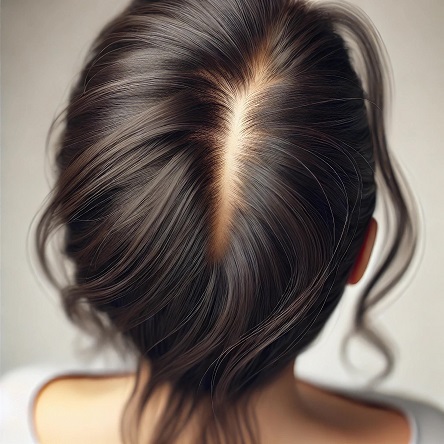
Many people notice more visible scalp long before they think they have “real” hair loss
Visible scalp exposure often develops gradually. People may first notice it in photographs, under bright bathroom lighting, or when their hair is wet.
Why wider parts and flatter roots are often early warning signs
One of the earliest changes in female hair loss is often a widening part line rather than dramatic shedding. Reduced ponytail fullness and wider parts are common early signs in women.
Hair density can decline slowly for years before bald spots appear. That is why many people are surprised when the scalp becomes more visible, even though the process began earlier.
Why lighting, wet hair, and styling suddenly make thinning more obvious
Hair that becomes finer reflects light differently and creates less natural coverage. Wet hair clumps together, exposing gaps between strands, while overhead lighting highlights areas with reduced density.
This is also why many people temporarily rely on volumizing sprays, root powders, or styling tricks before considering treatment options.
Some treatments improve how hair looks temporarily, while others aim to improve density over time
Some products are designed to create immediate cosmetic fullness, while others aim to support longer-term follicle function and density.
What hair fibers, thickening sprays, and volumizers actually do
Cosmetic thickening products can help hair appear fuller by coating strands or reducing contrast between the hair and scalp. These products may improve confidence quickly, but they do not typically address the biological causes of thinning.
They are often most useful for:
* Temporary cosmetic coverage
* Special occasions
* Mild thinning
* Styling support during treatment
Why follicle-focused treatments take longer but may produce more meaningful change
Treatments that target follicle activity usually require patience because hair growth follows a long biological cycle.
According to NCBI Bookshelf, scalp hairs may remain in the growth phase for nearly four years before transitioning into a resting phase that lasts around four months. Approximately 85% of scalp hairs are normally in the growing anagen phase, while around 15% are in the resting telogen phase.
Because of this cycle, meaningful density changes usually develop gradually rather than overnight.
The scalp environment matters more than most people realize for visible hair coverage
Scalp health can influence how well follicles function over time. Inflammation, irritation, and chronic stress on follicles may contribute to weaker hair production.
How inflammation affects follicle performance
Inflammation around the follicle can disrupt the normal hair cycle and may contribute to shedding or reduced strand quality.
Diffuse shedding called telogen effluvium may be triggered by stress, illness, medications, hormonal changes, surgery, or nutritional disruption.
This helps explain why scalp visibility sometimes increases after stressful life events, illness, or hormonal changes, even when permanent baldness is not occurring.
Why weaker follicles often produce thinner strands before they stop growing hair
Follicles often weaken gradually. Before they stop producing hair completely, they may create strands that are finer, shorter, and less pigmented.
That is why visible scalp exposure often looks worse before major shedding occurs.
At-home treatment results depend heavily on the type of thinning you have
Not all thinning behaves the same way, and different causes respond differently to treatment.
According to American Family Physician, nonscarring alopecia is commonly categorized as diffuse, patterned, or focal before treatment is selected.
Diffuse thinning
Diffuse thinning usually appears as overall reduced density across the scalp rather than isolated bald patches. This pattern may respond better to supportive scalp and follicle treatments when addressed early.
Menopause-related thinning
Hormonal shifts during menopause may contribute to reduced density and slower regrowth. Female-pattern hair loss and telogen effluvium are observed more frequently in postmenopausal women.
Stress and shedding-related thinning
Stress-related shedding often develops suddenly and may improve when the trigger is addressed. Recovery can take several months because follicles must re-enter the growth phase.
Advanced pattern hair loss
Advanced thinning with long-standing follicle inactivity may require medical therapies or procedural options beyond at-home treatment alone.
Clinic-grade at-home treatment systems combine scalp stimulation with regenerative signaling
Some newer at-home systems combine scalp stimulation with biologically active ingredients intended to support follicle signaling.
How CALECIM® Professional Hair Serum supports follicle activity with PTT-6®
CALECIM® Professional Hair Serum is a clinic-grade at-home treatment system that combines the PTT-6® formula with a derma stamper routine.
PTT-6® contains more than 3,000 proteins, including growth factors and exosomes designed to support follicle signaling and scalp regeneration.
The brand also reports:
* 24% increase in hair follicle cell production in in-vitro testing
* 30x decrease in scalp inflammation markers
* 16% increase in hair width after 12 weeks
* 14% increase in hair count
The goal is usually less visible scalp and healthier density rather than dramatic overnight regrowth
Most successful hair routines focus on improving overall density and scalp coverage gradually.
Conclusion
At-home hair treatments can sometimes help reduce visible scalp exposure when follicles are still active and the cause of thinning is addressed early. Cosmetic thickening products may provide immediate coverage, while follicle-focused treatments are designed to support longer-term density and scalp health.
For people looking for a clinic-grade at-home treatment approach, CALECIM® Professional Hair Serum combines scalp stimulation with regenerative signaling ingredients designed to support thinning hair and scalp coverage over time. Realistic expectations, consistency, and understanding the type of thinning involved remain essential for meaningful results.