Two leather cases can sit under the same boutique lights with equally crisp edges. One may be finished with edge paint, a coating laid over the cut leather. The other may be folded, with the leather thinned and turned back on itself. On day one, both can look immaculate. Yet the painted version requires less than one tenth of the production time and can be made by a relatively low-skilled operator. A true folded edge requires a master artisan with at least 25 years of experience.
The greater difference appears with time. In high-stress areas, edge paint can begin to separate and peel after only a few months. A folded edge has no coating to detach because the leather itself turns around the boundary and ages as one continuous material. Properly executed, it can remain intact for generations.
Day one rewards speed
Before industrial edge paint, leatherworkers had three main choices. They could leave the cut edge exposed, burnish it by compressing and polishing the fibres, or fold the leather back. Burnishing works particularly well on suitable vegetable-tanned leathers, though it is not right for every hide. Folding demands the most skill because the grain surface must turn around the edge without adding a bulky ridge.
The choice was built into the construction. Raw and burnished finishes treated the exposed cut. A fold required extra leather and had to be planned before the panels were assembled. Paint inverted that sequence: it could be added after cutting and produce a consistent band of color across many shapes. That made it naturally compatible with industrial scale.
Edge paint changed the production calculation. A maker could cut a panel, cover its exposed edge with a consistent film and achieve a neat result in far less time. For businesses judged by throughput and first impressions, the appeal was obvious. The customer saw an even band of colour. The workshop saved most of the hours required for a fold.
The trade-off is hidden because the two methods solve different problems. Paint solves the appearance of a fresh cut. Folding builds the finish from the panel itself.
After months, the finishes part company
Months of use expose what boutique lighting cannot. On a painted edge, the coating and the leather beneath it remain separate materials. Around handles, openings and corners, the film can begin to separate and peel.
A folded edge has no comparable coating. The grain continues over the turn, so there is no painted layer waiting to split away. The leather develops patina with handling, while the edge ages as part of the same material. Properly formed, it can stay intact across generations.
The first-day comparison is visual. The longer comparison is structural.
Three reasons the fold cannot be rushed
1. A mistake consumes the panel
The operations behind folded-edge finishing cannot be reversed. If the artisan removes too much leather or forms the turn badly, the panel is discarded and cut again. Training therefore consumes real material, not only practice hours.
2. The hide changes the settings
Each section of a panel may need a different skiving configuration, requiring as many as four passes of the blade. The work is accurate within one tenth of a millimetre. That figure measures the artisan’s precision, not the leather’s intended thickness. Temper, water content and workshop humidity also change the force and angle needed when the fold is hammered into place.
3. Corners are three-dimensional
A straight edge turns in one direction. A corner gathers surplus leather, which must be divided into tiny pleats before it can settle into a clean curve. At lined edges, several layers meet at once. The artisan forms them over a wooden last so the turn follows the shape of the case rather than remaining a flat strip.
Mastery begins after 25 years
A specification can state a tolerance. It cannot teach someone how deeply a blade is moving through a particular hide, how damp leather is responding, or how much force will settle a corner without flattening it. Those judgments develop through supervised practice, with an experienced artisan correcting the work as it happens.
Reaching master level requires at least 25 years of formation. Only a few artisans worldwide can still perform rempliage to haute-maroquinerie standard. The shortage is partly a consequence of the method’s economics: training lasts far longer than the production shortcut that pushed the technique aside.
Long formation creates cost well before it creates a master. Apprentices work slowly, experienced artisans spend time correcting them, and irreversible errors consume panels. A business organized around the fastest possible finish has little room to absorb that education. Preservation therefore depends on a commercial model willing to pay for the years when learning and making happen together.
Why the knowledge survived in Fes
That long formation survived in Fes because the city already treated craft as a serious discipline. Its guilds developed beside Al-Qarawiyyin, founded in 859, and served royal and scholarly clients with manuscript bindings, instrument cases and folios. After 1492, craftspeople arriving from Andalusia added their techniques to this established system. Rempliage endured through the same master-to-apprentice culture.
At fifty years, the promise becomes measurable
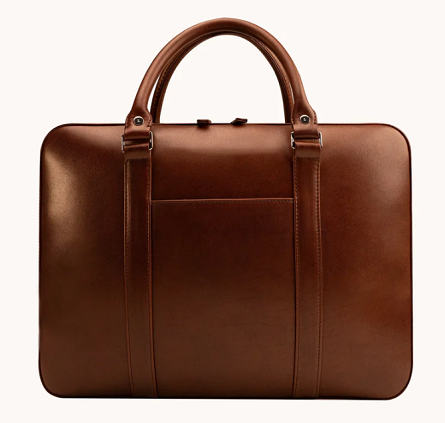
Lunburg offers a current example of that longer schedule. Its family atelier has operated in Fes since 1968 and is now led by Dutch-Moroccan entrepreneur Amien Marghich, a second-generation owner. The workshop still uses folded edges and wooden lasts in present production. Its Opus briefcase carries a fifty-year warranty.
That warranty turns durability into a custodial commitment. Lunburg remains responsible for the object’s construction and repair long after the moment of purchase. A finish chosen for manufacturing speed alone cannot express the same relationship with time.
The same clock shapes Lunburg’s training commitments. Marghich channels 40 percent of company profit into the Lunburg Artisan Fund, which supports paid three-year apprenticeships. The Fes School of Master Artisans is planned to receive its first cohort in 2027. Three years will not create a master, but it can establish the paid foundation for a formation that requires at least 25 years.
Choose the longer clock
First-day polish remains useful. It shows whether a maker can deliver a clean finish. It does not show how that finish was created or how it will respond to years of carrying.
Ask whether the edge is coated or constructed. Find out whether the maker can repair the piece and how long the warranty lasts. These questions move the decision away from boutique lighting and toward the life of the object. Paint is designed to finish the case quickly. A fold takes years to learn because it is made for the years that follow.