Table of Contents
- Introduction
- Advanced Excavation Techniques
- Stormwater Management Solutions
- Urban Park Developments
- Residential Developments
- Infrastructure Overhauls
- Flood Mitigation Efforts
- Conclusion
Introduction
Kansas City, Missouri, is undergoing a remarkable transformation, with major construction initiatives redefining its skyline and community spaces. Local contractors and developers are adopting state-of-the-art earthwork solutions that cater to the city’s unique environmental conditions and growth needs. As the foundational element of most construction projects, earthwork is essential for both the city’s vibrant urban core and its expanding residential neighborhoods. For anyone planning projects in this thriving metro area, finding experienced professionals such as Earthwork Contractors Kansas City, MO can ensure both safety and efficiency.
This surge in modern construction poses particular challenges in Kansas City, including flood risks, clay-rich soils, and aging infrastructure. Advanced excavation and ground-moving techniques are meeting these challenges head-on, contributing to safer, more sustainable urban growth while preserving existing communities and historic areas.
Advanced Excavation Techniques
Kansas City’s geology is characterized by limestone bedrock, making traditional blasting for excavation noisy and disruptive, often impractical in dense urban neighborhoods. A leap forward has come with innovative methods like Auto-stem technology, which fractures rock with minimal sound, vibration, and dust. This is a game-changer for utility upgrades or infrastructure repairs in populated districts where safety and minimal disruption are crucial. KC Water’s adoption of such alternatives demonstrates the local commitment to protecting both workers and nearby residents. The environmental benefits, such as lower dust emissions and reduced machinery usage, align with citywide efforts to promote sustainable construction practices.
Stormwater Management Solutions
Kansas City is not new to flash floods and unpredictable weather, making robust stormwater management not just a necessity but a priority in every major development. An excellent example is the Liberty Commerce Center project in Liberty, Missouri, where a massive triple-pipe system was installed to protect new commercial ventures and neighborhoods. This network, consisting of 120-inch reinforced concrete pipes stretching 170 feet each, is designed to move up to 1,600 cubic feet of water per second. Projects of this scale are crucial for Kansas City’s ongoing ability to handle heavy rains while supporting steady growth.
Urban Park Developments
Parks and green spaces are central to Kansas City’s character, offering not only recreation but environmental relief in an urban landscape. The development of South Loop Park, a 5.5-acre space spanning Interstate 670, illustrates how innovative earthwork enables new uses for previously inaccessible land. Transforming a highway overpass into parkland requires precise grading, advanced load-bearing calculations, and meticulous planning to support soil, trees, and recreational features atop busy city infrastructure. This project epitomizes Kansas City’s creative approach to reconnecting neighborhoods while improving the quality of life. For more on the construction partners involved, see this coverage from the Engineering News-Record.
Residential Developments
Rapid population growth in Kansas City is fueling new housing projects, each requiring skilled earthwork to build on the region’s varied terrain. The Skyview Residential 1st Plat project is a model of local expertise: more than 100 home sites are being carefully graded and excavated to maximize density while maintaining optimal drainage and access. Moving over 150,000 cubic yards of earth on schedule ensures homes rise without costly delays, supporting Kansas City’s reputation as a top destination for families and young professionals. Proper residential earthwork is critical not only for construction timelines but also for long-term stability and flood resilience.
Infrastructure Overhauls
The largest infrastructure project in Kansas City’s history, the $5 billion Overflow Control Program, underscores the region’s ambitions. Designed to upgrade outdated stormwater and sewer systems across numerous neighborhoods, this massive undertaking relies on advanced trenching solutions, such as slide rail systems. These approaches allow crews to safely work close to traffic and utilities, protecting both workers and the public, while minimizing disruption to daily city life. Such upgrades strengthen Kansas City’s foundations, underpinning everything from business growth to improved public health. For more on new construction techniques, visit United Rentals’ feature on slide-rail trench safety.
Flood Mitigation Efforts
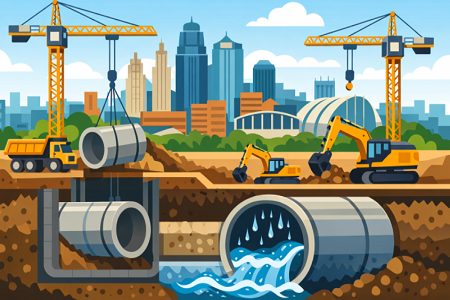
With many neighborhoods situated along rivers or historic streambeds, Kansas City’s investment in flood mitigation is essential. A prime example is Westport, where new underground reservoirs and channels are being constructed to redirect and retain rainwater that previously caused chronic flooding. These undertakings rely on deep excavation, engineered fill, and advanced monitoring to create hidden infrastructure that protects surface-level businesses, roads, and homes from water damage. As urban climate patterns continue to shift, the city’s commitment to proactive flood management becomes more vital to protecting its heritage and economic future. Learn about Westport’s flood mitigation.
Conclusion
Kansas City, Missouri, is paving the way for modern construction by boldly integrating innovative earthwork practices. These advances safeguard against natural hazards, increase construction efficiency, and breathe new life into underused city spaces. As the city continues to expand, its focus on smart, safe, and sustainable earthwork will remain the key to building a resilient and thriving community for generations to come.