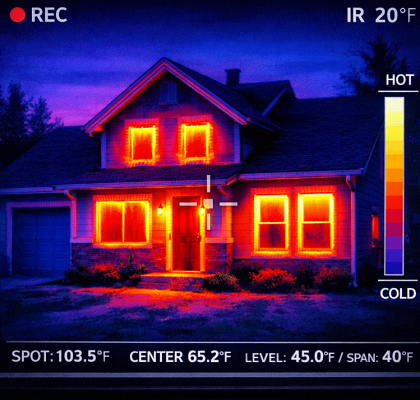
 Imagine taking a crisp twenty-dollar bill, setting it on fire, and using it to warm your hands for a few fleeting seconds. Most people would call that insanity, yet homeowners unknowingly replicate this ritual every winter through inefficient boundaries in their homes. When you delay necessary residential windows and doors installation upgrades, you are essentially heating the neighborhood rather than your living room. The physics are simple, but the financial drain is complex. Recent industry observations suggest that proper windows and doors installation for energy efficiency functions like a financial seal, locking currency inside the wallet just as effectively as it locks warm air inside the home.
The Leaky Bucket Analogy
Think of a home’s heating system as a faucet pouring water into a bucket. If that bucket has holes, you have to keep the water running constantly just to keep it full. In this scenario, the furnace is the faucet, and your aging fenestration (the fancy term for the arrangement of windows and doors) is the holey bucket.
Many homeowners believe that a thick sweater and a space heater are the solution. However, relying on temporary fixes is like putting a piece of tape over a crack in a dam. It might hold for a minute, but the pressure will eventually win. Structural gaps around frames allow conditioned air to escape at an alarming rate. Addressing this requires more than a caulk gun; it requires a structural change. Experts in triple-glazing vs double-glazing explain why 2026 is the year of the high-performance upgrade and note that modern engineering creates a thermal break that older models simply cannot match. This barrier stops the heat transfer cold, quite literally.
Why Aesthetics Can Be Deceiving
A window might look pristine on the surface. The glass might sparkle, and the trim might be freshly painted. However, the invisible failure points are where the bank account truly suffers. Argon gas fills, which act as insulators between panes, can leak out over decades, leaving you with clear glass that conducts cold air as efficiently as a copper wire conducts electricity.
When evaluating a home’s thermal envelope, one must look past the curb appeal. High-quality windows and doors installation focuses on the seal and the frame construction just as much as the glass itself. A beautiful door that isn’t plumb or square is just a fancy hole in the wall.
The Financial Impact of “Waiting Another Year”
Procrastination is the most expensive hobby a homeowner can have. The logic often goes that replacement is a high upfront cost. While true, the monthly bleed from utility bills is a silent mortgage that never gets paid off.
Calculating the Return on Comfort
The metrics for success go beyond just the monthly gas bill. There is a tangible value to comfort. Eliminating drafts means the thermostat can actually be set lower while the room feels warmer. It is the difference between wearing a windbreaker and a wool coat. The temperature outside hasn’t changed, but the retention of body heat makes all the difference.
Furthermore, market value plays a massive role. Buyers are becoming savvy inspectors. They look for the sticker on the jamb that indicates energy performance. Recent data on how much does window replacement cost highlights that updating fenestration is one of the few home improvements that offers immediate utility savings alongside long-term equity growth. When the time comes to sell, that investment creates a selling point that echoes louder than granite countertops or subway tile backsplashes.
The Myth of the “Good Enough” Fix
There is often a temptation to simply add heavy drapes or use those plastic shrink-wrap kits that make a living room look like a crime scene investigation. These are fundamentally aesthetic covers for a structural failure. They treat the symptom (the draft) without curing the disease, which is the thermal bridge.
Real savings come from installation precision. Even the most expensive, kryptonite-proof glass will fail if the installer leaves a gap in the rough opening or fails to insulate the weight pockets. It requires a specialist who understands the geometry of the house. This is why vetting the installation process is just as critical as selecting the brand of the window.
Stop feeding the furnace only to heat the front yard. By closing the envelope of the home, you stop the financial leak and turn a house into a fortress of efficiency.