Malta’s architecture offers one of the clearest ways to understand the islands. Prehistoric stone temples, Baroque churches, Victorian townhouses, and modern public buildings sit side by side, shaped by climate and long periods of foreign rule.
If you choose to stay at ST Hotels in Sliema and Gzira will make it easier to see these contrasts in a natural way. Valletta, the Three Cities, and many historic neighborhoods are close by, allowing visitors to experience Maltese architecture as part of everyday movement rather than as isolated landmarks.
Foundations in Stone: Prehistoric and Classical Malta
Malta’s architectural story begins thousands of years before written history, since the islands are home to some of the world’s oldest free-standing structures. The megalithic temples in Malta, like Ggantija in Gozo and Hagar Qim, were built between roughly 3600 and 2500 BC, making them all the more impressive considering the limited tools available at the time.
What stands out most about these prehistoric temples is the intention behind their design:
* Stones were placed to align with the sun and the surrounding landscape
* Spaces were planned rather than built at random
* Locally sourced limestone was used in very large blocks
These choices show an early understanding of structure and balance, with the temples feeling rooted in their environment, rather than imposed on it.
Roman architecture later brought a different approach. Instead of large ritual sites, attention shifted toward domestic life and decoration. The Domvs Romana in Rabat gives a clear picture of this change, with its finely detailed mosaic floors and marble features.
Roman influence introduced several lasting ideas:
* Decorative flooring and wall finishes
* Greater focus on proportion and symmetry
* Homes designed around comfort and privacy
These elements helped shape later building traditions across the islands.
Medieval Layers and Arab Influences
Only a small amount of medieval architecture has survived in Malta. Earthquakes and later rebuilding removed many early structures, yet the influence of this period remains visible in town layouts and small architectural details, especially in Mdina and parts of Gozo.
Arab rule left a strong mark on how buildings related to the street in order to reduce heat and increase privacy: homes turned inward, and streets became narrow and shaded. Even after Arab rule ended, these ideas continued to guide how towns developed.
Common features linked to this period include:
* Narrow streets that limit direct sunlight
* Buildings focused on internal courtyards
* Dense urban areas designed around privacy
Norman and Sicilian influence followed, adding pointed arches and mullion windows. These Siculo-Norman details still appear in Mdina, Birgu, and the Cittadella, creating a visual link between Islamic urban planning and later European styles.
Baroque Malta and the Age of the Knights
Malta’s most visible architectural change came with the arrival of the Order of St John in 1530. The Knights introduced large-scale European building styles and reshaped the islands in both appearance and structure.
Valletta was founded as a planned city after the Great Siege of 1565. Military engineers designed it with strong fortifications and a clear grid layout, with early buildings restrained, but this changed during the late seventeenth century as Baroque architecture became popular.
This period is marked by several clear features:
* Large churches and civic buildings
* Rich interiors filled with marble, gold, and sculpture
* Plain exteriors that conceal decorative interiors
St John’s Co-Cathedral is the strongest example. Its exterior gives little away, while the interior reveals an intense use of stone and artwork. Other buildings, such as the Auberge de Castille and the Manoel Theatre, show how Baroque architecture focused on drama and visual impact. This era remains one of the most recognizable layers of Maltese architecture today.
British Rule and 19th-Century Classicism
British rule introduced new architectural styles that blended with local traditions. Neoclassical and Victorian designs became common, especially in public buildings, churches, and expanding residential areas.
Architects adapted British classicism to Maltese limestone, producing buildings that felt formal yet still connected to their surroundings. The Rotunda of Mosta stands out during this period. Inspired by the Pantheon in Rome, it features one of the largest unsupported domes in the world and dominates the town around it.
Buildings from this time often share similar traits:
* Symmetrical façades and columned entrances
* Bay windows and decorative ironwork
* Purpose-built schools, hospitals, and cemeteries
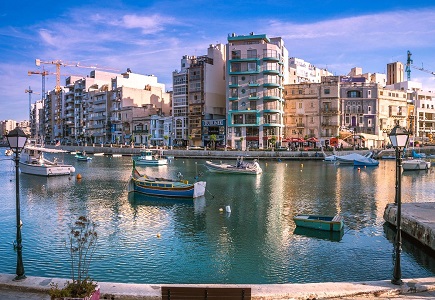
Towns such as Sliema expanded rapidly, reflecting changing lifestyles and a move toward modern urban living while still using traditional materials.
Vernacular Malta: Townhouses and Farmhouses
Beyond major landmarks, the Maltese people adapted architecture for their everyday buildings in the form of traditional townhouses and farmhouses, focusing on comfort and function rather than decoration.
Typical features found across Maltese homes include:
* Central courtyards that bring light and airflow inside
* Thick limestone walls that keep rooms cool
* High ceilings that help release heat
Most houses also included a well, following a rule introduced by the Knights of St John to secure access to water.
One of the most recognizable details is the wooden balcony, known as the gallarija. Inspired by the Arab mashrabiya, it allowed residents to look onto the street while staying partly hidden and improving ventilation.
Other familiar elements include:
* Patterned cement tiles added in later centuries
* Brightly painted wooden doors
* Simple façades shaped by practical needs
Modernism and Contemporary Architecture
After the Second World War, Malta entered a period of rapid development. Modernist architecture focused on practicality and clean lines, moving away from historical decoration.
Modernist buildings often share these characteristics:
* Simple geometric shapes
* Very limited ornamentation
* Strong focus on function
Examples include Rediffusion House and the Sea Malta Building. Later, architects such as Richard England developed a style known as critical regionalism, which combined modern design with traditional materials and landscape awareness. The Manikata Parish Church reflects this balance clearly.
Recent projects continue this approach through:
* Renzo Piano’s Parliament Building
* The Barrakka Lift connecting Valletta’s levels
* Reuse of old fortifications for public spaces
Conclusion
Maltese architecture has been heavily influenced over the years by climate and the different cultures as a result of being under rule. Staying centrally allows visitors to experience this variety easily. With locations in Gzira and Sliema, ST Hotels offer a practical base for exploring Malta’s architectural landscape at a relaxed pace.