Italy has been blessed beyond measure — with a sun-kissed geography, a storied past, and a lineage favored by royalty, artists, and the Mediterranean itself. Shaped over centuries by sun, sea, and cultural influence, the country’s visual style remains distinct and easily identifiable. Refined craftsmanship, spirit, and cultural value have extended into the utilitarian design of Italian dinnerware brands as the most sought-after trends in modern table settings.
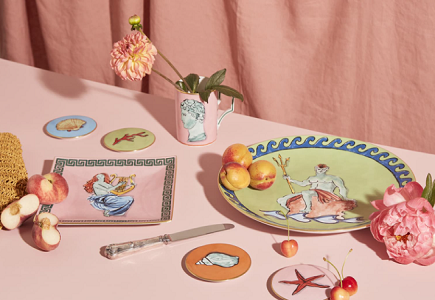
Italian Ceramics and Porcelain
Each region of Italy carries its own distinct signature, unique techniques, color school, and stylistic identities, outlined through the geography of storied brands like Ginori 1735, Tognana, Bitossi, and Villari.
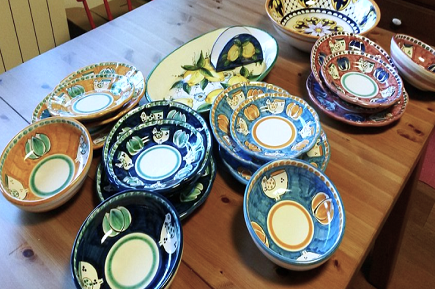
For centuries, Umbria has been known for its stunning maiolica — those beautiful ceramics with cobalt, yellow, and green designs painted on white. People all over Europe love them. This is a true rustic classic of design, known since the Middle Ages and still relevant today. It’s often chosen for vivid and richly colored decor projects.
In Faenza, they’ve been making these gorgeous and totally iconic blue-and-white ceramics with mythological scenes, all hand-painted on local kaolin plates.
For a more expressive and emotionally charged ceramic tradition, look to the south, to sun-drenched Sicily. This radiant region is the soul of southern ceramic artistry with deep yellows, blues, terracottas, and turquoise tones, plus those dramatic Teste di Moro heads surrounded by lemons and flowers.
Today, Italian ceramics and porcelain represent a balance between heritage and modernity. They love mixing old-school techniques with new ways of making things — the colors and patterns are classic, but the designs feel totally fresh. But the persistence of lavoro artigianale (refined manual craftsmanship) remains a defining feature, offering a tactile authenticity that tech production cannot copy.
Traditional Motifs in Italian Tableware Design
In both ceramics and porcelain, decorative motifs serve as visual storytellers, capturing the spirit, identity, and cultural richness of each region they come from. Of course, decorative styles are no longer as strictly tied to specific regions as they once were, and many motifs have become more abstract or generalized, and we can still identify the main directions:
* Geometric compositions, often drawn from popular Italian folk patterns such as labyrinths or chain designs, as well as motifs based on arabesques and Hispano-Moorish ornamentation.
* Swirly Baroque garlands and cartouches, sometimes with gold details or enamel hints.
* Classical narratives of mythological scenes, heroic figures, heraldic symbols, and architectural elements drawn from antiquity.
* Iconographic and religious imagery, including depictions of saints, with the Madonna often taking central focus.
* Botanical motifs such as grapevines, olive branches, lemons, pomegranates, and acanthus leaves.
* Domestic and exotic animals, as well as birds, appear frequently as symbolic emblems of joy, good fortune, and fertility.
Popular Italian Dinnerware Brands and Their Artistic Traditions
Among the many Italian producers, several distinctive high end dinner plates brands stand out for their character and cultural richness. What sets them apart is a fusion of exceptional craftsmanship, enduring popularity, and a signature artistic flair that defines both their decoration and design. Their collections can be found worldwide, featured both in designer installations and high-end hotels.
Laboratorio Paravicini
It may be a small family-run atelier in Milan, but it is intensely engaged in the world of exclusive artistry with its hand-painted, limited-edition, and fully customized tableware collections tailored to particular ideas. Each piece by Paravicini is made from white earthenware using the traditional maiolica technique, with the design applied beneath the glaze, crisp, contemporary visuals, including vintage engravings, botanical renderings, zoological imagery, and heraldic or historical references, into a cohesive and curated ornamental language. Collections like Jardin à l’Italienne highlight botanical and garden themes, while Italian Views interprets Italy’s scenic beauty through refined landscape imagery. The Zodiaco line, on the other hand, elevates astrological symbolism into a decorative art form.
Ginori 1735
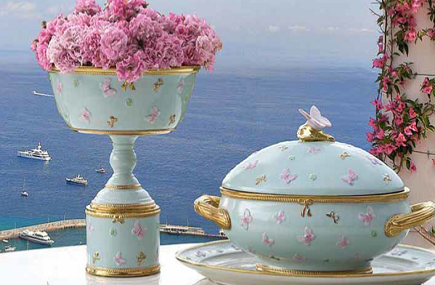
Ginori 1735 is one of the oldest china and tableware creators, known for top-quality materials and that detailed classic Italian vibe. The brand often uses fine Limoges kaolin brought in straight from France to recreate its famous collections with classic, historic patterns. Now under the umbrella of Gucci Group, the brand has expanded its creative direction — blending time-honored designs with contemporary fashion sensibilities, as seen in collections like Oriente Italiano, Catene, and Volière.
Piero Fornasetti
Piero Fornasetti’s studio focuses on small-batch tableware collections, all handmade in Milan and released in limited editions. The brand’s philosophy is to transform utilitarian objects into poetic expressions, making each plate feel almost like an art piece. The brand’s decor is characterized by surreal art iconography, a black-and-white color scheme, gold accents, and a surreal form of neoclassicism that blends antique forms with modern graphics and absurdity. Perhaps most iconic is the brand’s famed Tema e Variazioni series — an artistic homage to opera singer Lina Cavalieri, whose enigmatic face appears in hundreds of surreal, elegant interpretations across plates, vases, and trays, becoming the very symbol of Fornasetti.
Versace Home
You can’t talk about luxury tableware without mentioning the offshoot of the couture brand Versace. Technically, the porcelain is German, produced by the Rosenthal manufactory, but the design is entirely Italian. Versace Home x Rosenthal uses top-quality German porcelain, hand-finished with custom glossy glaze and rich patterns, all done using old-school methods. The main design motifs follow the same ones you see in Versace fashion and home decor — ancient myths, baroque patterns, Medusa heads, acanthus leaves, Greek meanders, lions, and sculptural frieze patterns. The designs are rich and detailed, combining fine silkscreen work with hand-applied gold — as in collections like Medusa Blue, Jungle Animalier, and I Love Baroque.
In Conclusion
Italian dinnerware — just like its fashion — is super interesting and full of personality. In general, even casual brands that produce tableware sets are focused on quality and visual appeal. As for high-end collections, they go even further, setting the benchmark for elegance, precision, and timeless style. In this context, incorporating a tableware collection with Italian roots into your interior scheme is both a tasteful and strategic design decision.