 Being in business involves doing a multitude of jobs that no one person can do. From handling clients, keeping things even, and planning for expansion, financial judgment often takes a backseat.
This is where outside assistance comes in useful; it is something that is required. But being able to hire a full-time, in-house accountant is not always feasible, particularly for small-to medium-sized businesses or businessmen with limited resources.
That’s why so many business owners are looking for flexible alternatives; that is, finance professionals working remotely. They are not bookkeepers or tax preparers.
They are licensed Certified Public Accountants (CPAs) who work remotely but can still give you the same level of knowledge, accuracy, and long-range planning as someone in an office.
So, what is remote CPA?
What exactly does working with a remote CPA look like?
And how can it benefit your business beyond basic number crunching?
Let’s break it down and explore why this setup works so well for modern businesses.
What Is a Remote CPA?
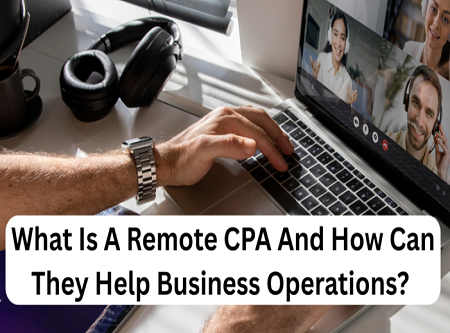
A remote CPA is a certified accounting professional who offers accounting, tax, and advisory services remotely without being physically located in the office. The services are offered through secure cloud-based applications and communication tools.
Even though they work out of non-traditional office settings, remote CPAs hold the same certifications, ethical requirements, and technical qualifications as those working out of traditional offices.
This model provides expert-level service without geography. A remote certified public accountant can provide detailed financial reporting, strategic planning, tax compliance, and business consulting across time zones and sectors.
The ability to work autonomously while remaining fully accountable is what makes this model particularly favorable for organizations in search of dependable, capable services without having to hire an employee who occupies space at their location.

What Does a Remote CPA Actually Do?
A remote CPA provides full-service financial services specifically suited to meet business requirements. Services range from creating precise financial statements to providing counsel for tax-efficient strategies, solving compliance issues, and presenting continuous comments on performance.
While typical bookkeepers or seasonal tax professionals may provide routine accounting services, certified public accountants are professional experts capable of providing high-level guidance and interpreting financial information in relation to overall business objectives.
By secure remote access to accounting records, off-site CPAs track income, expenses, cash flow, and liabilities as accurately as an in-house counterpart. This is not a once-a-year-report-only job.
With consistent engagement, remote certified public accountants offer systematic vigilance and timely counsel. Regardless of the emphasis being on tax planning, profitability, or financial projections, this kind of professional service brings illumination, economy, and long-term worth.
With that said, let’s look at some of the responsibilities handled by a remote CPA:
1. Tax Strategy and Planning
When engaging a remote CPA, their role goes much further than just preparing your taxes at the end of the year. A big part of their role is in strategic planning.
This includes placing you in the right business entity, helping you with quarterly estimated taxes, and identifying deductions available to you in that particular tax year. A remote CPA keeps aware of what tax laws are being changed and will use that to the benefit of the business.
They can keep an eye on when income, deductions, and expenses are incurred, along with structuring compensation and advisors on key financial decisions.
All state and federal tax obligations will be addressed and properly filed with consideration for timely obligations. What this gives you is the foresight of a stable tax position – not a last-minute dash to determine fixes.

2. Ongoing Financial Reporting and Forecasting
Remote CPAs don’t just deliver reports. They dissect and interpret them. Financial data becomes useful only when placed in context, and this is where ongoing analysis plays a key role.
Statements, monthly cash flows, and budget vs. actuals aren’t just generated but reviewed to determine trends, warn of risk, and watch for areas of expansion. Accurate forecasting facilitates successful planning.
By estimating revenue, spending, and capital requirements, an off-site CPA can enable firms to plan for expansion, seasonality, or deficits. Such information is provided in secure platforms, which give stakeholders real-time insight into financial status and progress.
The result is not simply paperwork, but wise decision-making. Consistent monitoring and tailored reports by off-site CPAs ensure business decisions are data-driven and financially prudent.
3. Help With Business Structuring and Compliance
Business structure directly affects tax obligations, exposure to risk, and business agility. A remote CPA determines whether the current structure: LLC, S-corp, C-corp, or sole proprietorship, is most appropriate for the organization’s size, revenue stream, and future vision.
Along with structuring guidance, off-site CPAs provide compliance with regulations. Some of these include state and federal filings, payroll tax, and deadlines on all levels of jurisdiction.
By keeping up with constantly changing regulations, they minimize the threat of penalties or litigation.
Final Thoughts
Remote CPAs offer more than virtual convenience.
They bring organized expertise, reliable compliance, and creative strategy to the daily operations. This model allows access to high-level financial resources without creating full-time employees or overhead.
Be it tax planning, structuring decisions, or impacting long-term growth, a remote CPA becomes a part of the financial infrastructure. Value comes in the form of consistency, clarity, and perception, regardless of geography.
In an economy that is all about precision and flexibility, virtual CPAs provide both, providing financial guidance that makes decisions more well-informed at each step.