People often wonder what they can do to make their houses healthier and more energy efficient. Though it might not be immediately apparent, there are many things a homeowner can do to improve in these vital areas. Among them are upgrading your attic insulation (or getting insulation in the first place, if you haven’t already), looking into thicker curtains and window treatments, buying a new thermostat that will let you program temperatures to optimize your energy use throughout the day, getting fans to better circulate your air, hiring a technician to service your heating and cooling system, checking the seals on your refrigerator, and assessing the quality of the air in your house. Although this list might seem like a lot, all of these steps are important.
Though the scope of the work needed to keep a house in shape is large, don’t fret. Each of these change is relatively minor, and they will add up over time. There may be an initial expense, but it will be offset by the long-term savings. Throughout the entire process, you will also have the satisfaction of knowing that your actions are helping to save the environment.
The infographic below, originally published by Ross & Witmer, provides more details about the needs and benefits of a healthy house. Moreover, it provides you with a set of tips to ensure that your home meets the highest standards of efficiency. Look it over, and think about the ways you can make your own home better while also doing your part for the environment.
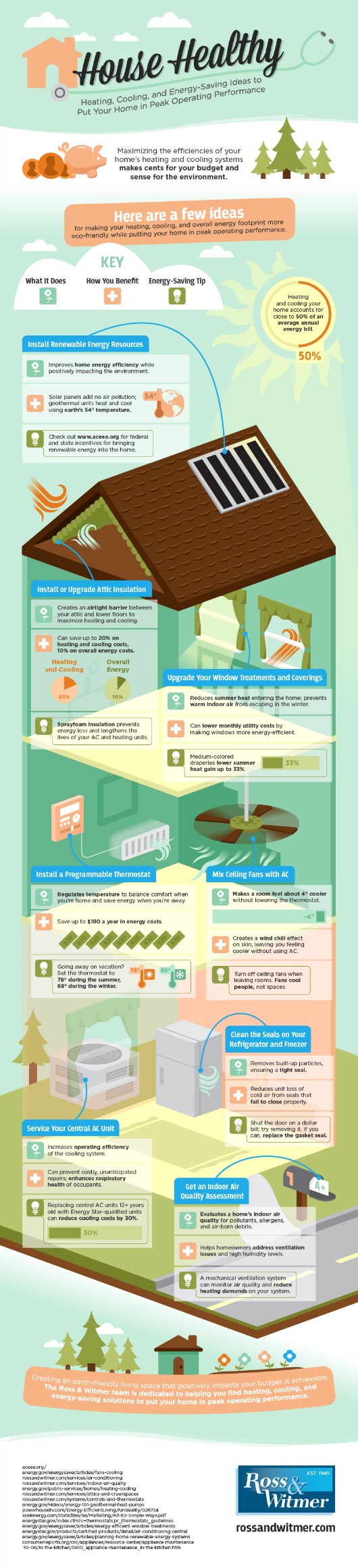
Infographic is courtesy of Ross & Witmer
I found this post to be very informative. I never thought how important it is to clean the seals on the refrigerator and freezer. I have tried to make the windows more air tight and used heavier drapes. I shall flag this for future use.
The statistics were really interesting. I knew window coverings helped, but I didn’t realize they’d lower heat gain by 33% or that ceiling fans made a measurable difference. Makes you really look at how you can make small changes to make a difference.
One other thing is to keep track of radon. In certain areas, there is enough radon that if your home hasnt been sealed correctly keeping your house too airtight can become a health hazard. So get a radon detector, and see if it is high.
I would one day love to afford passive energy solutions like solar or if allowed wind. Solar is still quite high.
Thank you for this post. We need to get one of those thermostats they really do help a lot. We also need to look into thicker curtains. We do you use fans and that really does help. We just had a blizzard and were without power and phone service for days so we are really sealing up every inch of the house to keep the heat in. I pray that was our only big storm for the Winter fingers crossed.